
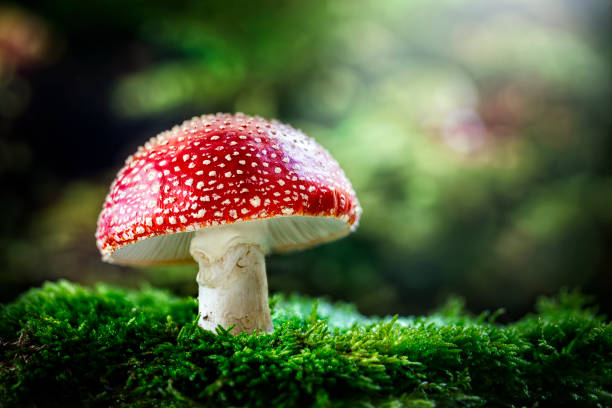
The Enchanted Story of the Christmas Mushroom: Exploring Origins, Folklore, and the Transformative Uses of Amanita muscaria
When we think of Christmas, visions of evergreen trees, red ornaments, and snow-dusted landscapes often come to mind. Yet woven quietly through northern European and Siberian history is a lesser-known symbol—one that shares the same bright red and white color palette that has come to define the season. This figure is the Christmas Mushroom, more formally known as Amanita muscaria.
Long before it appeared on holiday decorations, this mushroom carried centuries of myth, medicine, magic, and meaning. Today, its story is resurfacing—not as a trend, but as an invitation to reconnect with ancestral traditions, inner wisdom, and states of consciousness once revered for insight and connection.

Origins of the Name and the Christmas Connection
The red-capped Amanita muscaria grows beneath birch, pine, and spruce—trees that play a central role in winter solstice celebrations around the world. Its striking colors naturally draw attention, but its connection to Christmas stems from several overlapping threads of folklore.
Siberian Shamanic Traditions
In Siberian and Arctic regions, winter solstice ceremonies often included carefully prepared Amanita muscaria. Shamans would harvest the mushrooms from beneath evergreens, hang them to dry in tree branches, and then deliver them to community members during midwinter rituals. According to some traditions, these shamans arrived through the smoke hole or chimney when deep snow blocked doorways.
These details—bright red and white “gifts,” evergreens, chimney entry—echo through modern Christmas imagery. While not definitively the source of our contemporary holiday symbols, the parallels have inspired centuries of speculation and storytelling.
Norse and Saami Mythology
In certain Northern European myths, reindeer consumed the mushroom and displayed ecstatic, energized behavior afterward. These stories may have contributed to tales of “flying reindeer” seen during long winter nights when the veil between worlds felt thin.
Alpine and Central European Folk Art
For centuries, images of the red-and-white mushroom have appeared in Yule decorations, paintings, ornaments, and holiday cards as a symbol of good fortune and protection for the coming year. It became a seasonal emblem of transformation and renewal—qualities associated with midwinter.
The Mushroom as a Tool for Insight and Inner Journeying
While Amanita muscaria has a long history of ceremonial use, modern interest is emerging around its potential to support energy, restorative sleep, and dream exploration—when prepared and used safely and respectfully.
A Grounded Burst of Energy
Some people experience a gentle, grounded lift in energy—a focused alertness without agitation. This is not stimulation in the modern sense, but more akin to a sharpening of awareness, an enlivening of presence.
Deep Rest and Restorative Sleep
Paradoxically, after the initial wakefulness fades, the mushroom can support a state of relaxed calm. When used intentionally, this transition often leads to a night of deep, rejuvenating rest. Many describe it as a settling of the nervous system—a drop into parasympathetic restoration that feels both peaceful and profound.
Lucid Dreaming and Subconscious Exploration
Across cultures, Amanita muscaria has been used for dream work.
Users often report:
- Heightened dream clarity
- Increased lucidity or awareness within dreams
- Symbolic or meaningful imagery
- The sensation of receiving guidance or insight
For some, this dream space becomes a place of connection—with the subconscious, with inner archetypes, with ancestral wisdom, or with what they understand as their higher self, guides, or loved ones in spirit. These experiences are deeply personal and vary widely, yet many describe them as transformative.
Safety, Respect, and Preparation
Historically, the mushroom was never consumed raw. Traditional preparation methods—drying, parboiling, or carefully refining—were designed to reduce undesirable compounds and make the experience gentler and safer.
Modern explorers emphasize the same principles:
- Proper identification
- Knowledgeable preparation
- Respectful dosage
- Intention and a calm environment
- Avoiding combination with alcohol or other substances
- Consulting with qualified practitioners if any health concerns exist
Approached responsibly, the Christmas Mushroom becomes less of a “substance” and more of a teacher—one that has guided communities for hundreds of years.
Why the Christmas Mushroom Matters Today
Beyond its chemical properties or folklore, the Amanita muscaria reminds us of something profound: winter is a season of thresholds. As the world quiets, inner doors open. The subconscious becomes more accessible. Messages that are usually subtle become louder. Our dreams become richer, our intuition more available.
The Christmas Mushroom stands at the center of these themes—transformation, renewal, connection to the unseen, and the possibility of receiving guidance when we intentionally step outside ordinary awareness.
Whether we approach it through mythology, historical curiosity, or modern contemplative practice, it invites us to reconnect with ancient rhythms of winter and the deeper wisdom this season has always offered.
SAFETY DISCLAIMER:
This article is provided for educational, historical, and informational purposes only. It is not intended to promote, encourage, or instruct the use of any substance, nor does it constitute medical, psychological, or legal advice.
The Christmas Mushroom (Amanita muscaria) contains bioactive compounds and may carry significant risks if misidentified, improperly prepared, or used without appropriate knowledge and caution. Effects vary widely between individuals, and adverse reactions are possible.
Readers are solely responsible for their own choices, actions, and interpretations of the information presented. The author and publisher assume no responsibility or liability for any outcomes related to the use, misuse, or interpretation of this content.
Always consult a qualified medical professional before engaging in any practice that may affect your physical, mental, or emotional well-being. Never consume wild plants or fungi without expert identification and guidance.
By reading this content, you acknowledge and accept full personal responsibility for any decisions made based on the information provided.
REFERENCES:
Bennett, B. C., & Balick, M. J. Does the name “fly agaric” refer to a historical insecticide? Economic Botany, 2014.
Bjerke, E., Østby, E., & Pedersen, B. Human–fungus relationships in northern Europe: Cultural history and folklore of Amanita muscaria. Mycologist, 2003.
Hoffmann, E., Rätsch, C., & Schultes, R. E. Plants of the gods: Their sacred, healing, and hallucinogenic powers (2nd ed.). Healing Arts Press, 1990.
La Barre, W. The ghost dance: Origins of religion. Doubleday, 1970.
Nyberg, H. Religious use of hallucinogenic fungi: A comparison between Siberian and Mesoamerican cultures. Karstenia, 1992.
Ott, J. Pharmacotheon: Entheogenic drugs, their plant sources and history (2nd ed.). Natural Products Co, 1996.
Ruck, C. A. P., Bigwood, J., Staples, D., Ott, J., & Wasson, R. G. Entheogens. Journal of Psychedelic Drugs, 1979.
Saar, M. Ethnomycological data from Siberia and North-East Asia on the effect of Amanita muscaria. Journal of Ethnopharmacology, 1991.
Wasson, R. G., & Wasson, V. P. Mushrooms, Russia and history. Pantheon Books, 1957.
IMAGE SOURCE: iStock Photo

Take Action And Transform Your Life With The Blueprint Method
Discover the power of The Blueprint Method and unlock your full potential today.
Invest In Yourself ~ You Deserve A Happy, Healthy Life

Get the latest stories, exclusive insights, and special offers delivered straight to your inbox.
Subscribe now to receive the newest articles and be the first to know about our exclusive offers and product updates.
By submitting your information, you`re giving us permission to email you. You may unsubscribe at any time.

Have questions or suggestions for a future topic?
Contact us and send us a message or leave a comment below.