
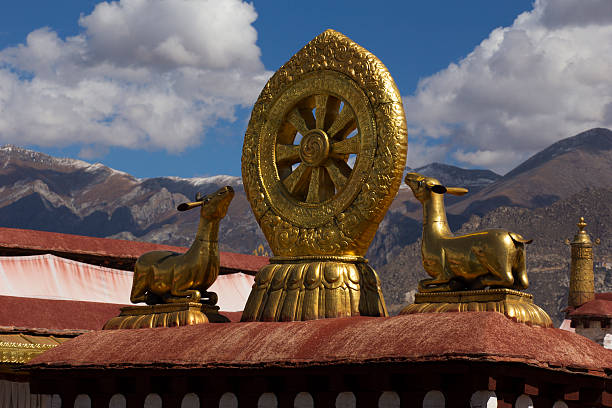
Dharma: Discovering The Purpose Written Into Your Blueprint
There is a question that eventually finds its way into many of our lives: Why am I here? We may ask it during a major transition, after accomplishing something we thought would make us happy, or when the life we have built no longer feels like it fits. Sometimes the question emerges quietly, as a persistent feeling that there must be something more. Other times, it arrives through disruption, loss, burnout, or a profound realization that we have been living according to expectations that were never truly our own.
The concept of dharma offers an interesting way to explore that question. Rooted in ancient Indian philosophy and carrying meanings related to duty, right action, order, and the way one lives in alignment with their nature, dharma is often described as an individual’s unique path or purpose. While the concept has deep spiritual and philosophical roots that extend far beyond any single interpretation, there is a powerful connection between dharma and your Blueprint. Rather than viewing purpose as something you need to go out into the world and find, perhaps consider that much of your purpose may already be encoded within who you naturally are.

Dharma Is More Than a Job or a Calling
When people hear the word purpose, they often immediately think about careers, accomplishments, or some grand contribution they are supposed to make to the world. We ask ourselves what we should become, what we should accomplish, or what impact we should leave behind. Dharma invites us to look at purpose from a broader perspective because it is not necessarily about a particular job title or achievement. It is about living in a way that is consistent with your nature and responding to life from that place of alignment.
This distinction matters because your purpose can express itself through many different circumstances throughout your life. A person whose Blueprint naturally draws them toward teaching may fulfill that part of themselves as a parent, military leader, coach, therapist, entrepreneur, friend, or community member. The external role may change, but the underlying expression remains. The same person may continue to teach, guide, encourage, explain, protect, or empower others regardless of what appears on their business card. This is why discovering your Blueprint comes before trying to define your purpose. Your purpose is not something you manufacture. It emerges from understanding the person you were designed to be and learning how that person naturally contributes to the world around you.
Your Blueprint Holds Clues to Your Dharma
Your human Blueprint is your authentic self, and it is explored through four interconnected elements: your dominant traits and characteristics, your intrinsic values and drivers, your natural gifts and talents, and the childhood voids that shaped what you learned to seek, create, protect, or provide. Together, these elements reveal patterns that can help you understand not only who you are, but why certain experiences, relationships, challenges, and desires have followed you throughout your life.
Your dominant traits provide clues about how you naturally move through the world. You may be naturally curious, compassionate, analytical, adventurous, independent, protective, creative, resilient, perceptive, or driven. These characteristics are not necessarily things you consciously decided to develop. They often seem to have been present in you for as long as you can remember. When you repeatedly suppress these natural characteristics in order to fit into an environment, relationship, career, or expectation, you may eventually experience a sense of disconnection from yourself.
Your intrinsic values and drivers reveal what matters deeply to you. Values become an internal compass that influences the decisions you make, the things that motivate you, and the experiences that feel meaningful. When your life allows you to live according to your values, there is often a sense of congruence because your external choices are reflecting your internal truth. When your circumstances consistently require you to violate those values, even success can begin to feel empty.
Your natural gifts and talents reveal what you are naturally equipped to contribute. There are things that seem to come more easily to you than they do to others, and you may have overlooked them precisely because they feel so natural. What you dismiss as “just something I’m good at” may be one of the very capacities through which your dharma expresses itself.
Then there are your childhood voids. These are not simply wounds to overcome or problems to fix. They can also provide important information about what you learned was missing, what you became sensitive to, and what you may eventually feel compelled to create for yourself or others. Someone who experienced a lack of safety may become deeply committed to creating security. Someone who felt unseen may develop an extraordinary ability to notice and understand other people. Someone who experienced a lack of belonging may eventually dedicate their life to creating community.
The goal is not to romanticize painful experiences or suggest that suffering was necessary for your purpose. Rather, it is to recognize that your experiences become part of your story, and your story can reveal patterns that help you understand the person you have become.
Dharma Lives at the Intersection of Who You Are and What You Give
One of the most important distinctions between purpose and identity is that purpose ultimately moves beyond the self. Your Blueprint describes who you are; your dharma describes how that authentic self is expressed through your life.
Imagine someone whose Blueprint contains a strong combination of empathy, curiosity, communication, and a deep value for freedom. Their purpose may not be a specific profession. Instead, the underlying pattern might involve helping people see possibilities they could not see for themselves and empowering them to make choices that are authentically their own. That expression could take many forms throughout their lifetime, from raising children to leading an organization to mentoring others to creating a business.
This is why trying to discover your purpose by asking, “What should I do?” can sometimes lead you in the wrong direction. A more revealing question may be, “Who am I, and what naturally wants to be expressed through me?” When you understand your Blueprint, the answer begins to become clearer.
The Difference Between Dharma and the Roles We Inherit
Much of what we call identity is actually a collection of roles we have accumulated throughout our lives. We become someone’s daughter or son, spouse, parent, employee, leader, caregiver, provider, veteran, business owner, or community member. These roles can be meaningful, but they can also become so intertwined with our identity that we forget there is a person underneath them.
This is particularly important when a major role changes or disappears. Retirement, divorce, children leaving home, career transitions, military separation, or the end of a long-term relationship can create an identity crisis because the structure that once defined our lives is suddenly different. We may find ourselves asking, “Who am I now?”
The answer is not found by immediately replacing the old role with a new one. It begins by returning to the Blueprint underneath the role. The person you were before the title, before the expectations, before the responsibilities, and before everyone else’s definition of who you should be is still there. Your dharma does not disappear when a role ends. The way your dharma is expressed may simply change.
When You Live Outside Your Blueprint
There is a difference between discomfort that accompanies growth and discomfort that comes from consistently living outside your authentic nature. Growth may challenge you while still feeling meaningful. Living out of alignment can leave you chronically depleted, resentful, disconnected, or unsure why something that looks successful from the outside does not feel successful on the inside.
You may have learned to prioritize security over freedom, achievement over connection, productivity over presence, or other people’s expectations over your own values. You may have become exceptionally good at being who everyone else needed you to be. Over time, that adaptation can become so familiar that you mistake it for your identity. This is where the Blueprint becomes particularly valuable. Instead of asking why you cannot simply be more motivated, disciplined, positive, or successful, you can begin asking a different question: Is the life I am creating actually compatible with who I am?
Sometimes the answer is uncomfortable. You may discover that the life you worked incredibly hard to build was based on someone else’s definition of success. You may recognize that the career you pursued no longer reflects your values or that a relationship requires you to continually suppress important parts of yourself. You may realize that what you thought was ambition was actually a desire for validation, or that what you thought was responsibility was actually fear of disappointing others. These realizations are not failures. They are feedback.
Your Life Can Become a Conversation With Your Blueprint
Feedback is one of the elements of the Blueprint Life because life is continually giving us information about our level of alignment. Our emotions, relationships, energy, challenges, successes, and even recurring frustrations can reveal something about the relationship between the life we are living and the person we are underneath it.
Dharma does not mean that everything should always be easy. Alignment does not eliminate difficulty, responsibility, or uncertainty. In fact, living according to your authentic Blueprint can sometimes require tremendous courage because your dharma may lead you away from what is familiar and toward something that asks you to grow.
The difference is that difficulty becomes meaningful when it is connected to something that matters to you. You can work hard and still feel aligned. You can experience fear and still know you are moving in the right direction. You can encounter obstacles without interpreting them as evidence that you are on the wrong path. The question becomes less about whether life is difficult and more about whether the difficulty is taking you toward or away from yourself.
Dharma Evolves as You Do
Another important consideration is that your purpose does not have to remain expressed in exactly the same way throughout your life. Your Blueprint provides a foundation, but you are not a static human being. Your values can evolve, your circumstances change, your awareness deepens, and new aspects of yourself can emerge through experience.
The person who feels called to serve others at twenty-five may express that service differently at forty-five. The person whose purpose initially manifests through a career may later express it through family, community, entrepreneurship, mentorship, or creative work. What remains consistent is often not the specific activity but the underlying pattern of contribution.
This is why discovering your Blueprint is not a one-time exercise. It is an ongoing relationship with yourself. As you become more aware of your dominant traits, values, gifts, and formative experiences, you become better equipped to recognize the different ways your purpose can express itself throughout the various seasons of your life.
Your Dharma Is Not Something You Have to Earn
Perhaps one of the most liberating aspects of looking at dharma is recognizing that your purpose is not a prize waiting for you at the end of your accomplishments. You do not have to become more impressive, successful, productive, or worthy before you are allowed to live purposefully. Your purpose can be expressed in the way you raise your children, the way you lead your team, the way you care for your community, the way you create, the way you solve problems, the way you make people feel seen, or the way you bring your natural gifts into whatever environment you occupy.
The question is not whether your life is important enough to have purpose. The question is whether you are allowing your authentic self to participate in the life you are living. When you stop treating purpose as something outside of yourself that must be discovered and start seeing it as something that emerges from your Blueprint, the search changes. Instead of chasing a destination, you begin paying attention to the patterns that have been present all along.
Discovering the Life You Were Meant to Live
Dharma becomes an invitation to come home to yourself. It asks you to look beneath the roles you have inherited, the expectations you have accepted, and the identities you have constructed and reconnect with the person who has been there underneath it all.
Your Blueprint contains clues. Your values tell you what matters. Your traits reveal how you naturally move through the world. Your gifts reveal what you have to contribute. Your childhood experiences can illuminate what you have learned to seek, protect, create, or provide. When these pieces begin to come together, your purpose becomes less mysterious.
Perhaps your dharma has never been about becoming someone else. Perhaps it has always been about becoming more fully yourself. And perhaps the life you were meant to live is not waiting somewhere ahead of you. Perhaps it begins when you stop living outside your Blueprint and start allowing it to lead.
REFERENCES:
Frankl, V. E. Man’s search for meaning. Beacon Press, 2006.
Ketabi, S. H. Ayurveda [Idiot’s Guides]. DK, 2017.
Schwartz, S. H. An overview of the Schwartz theory of basic values. Online Readings in Psychology and Culture, 2012.
IMAGE SOURCE: iStock Photo

Take Action And Transform Your Life With The Blueprint Method
Discover the power of The Blueprint Method and unlock your full potential today.
Invest In Yourself ~ You Deserve A Happy, Healthy Life

Get the latest stories, exclusive insights, and special offers delivered straight to your inbox.
Subscribe now to receive the newest articles and be the first to know about our exclusive offers and product updates.
By submitting your information, you`re giving us permission to email you. You may unsubscribe at any time.

Have questions or suggestions for a future topic?
Contact us and send us a message or leave a comment below.
Leave a Reply