
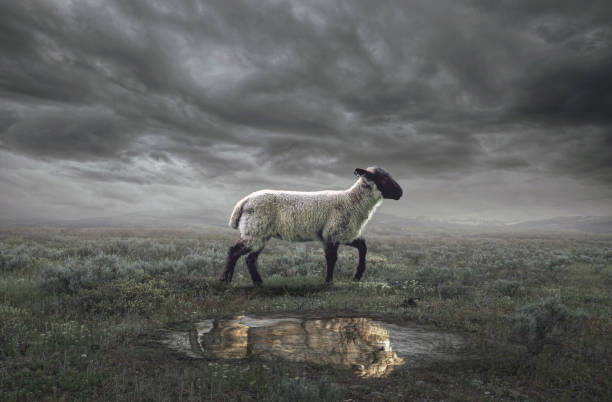
March: In Like a Lion, Out Like a Lamb?
As we step into the month of March, we often hear the familiar saying: “March comes in like a lion and goes out like a lamb.” It’s one of those phrases that feels poetic and symbolic, yet it is also deeply rooted in seasonal observation.
But what does it really mean? And where did it come from?
Let’s explore the history, the symbolism, and the natural rhythms behind this enduring expression.

What Does “In Like a Lion, Out Like a Lamb” Mean?
The saying refers to the changing weather patterns in March, particularly in the Northern Hemisphere.
- “In like a lion” suggests that March often begins with fierce, wintry conditions—strong winds, cold temperatures, snow, and storms.
- “Out like a lamb” implies that by the end of the month, the weather becomes calmer, milder, and more spring-like.
In other words, March can start off roaring but end gently.
Examples in Everyday Life
You might notice:
- Early March snowstorms followed by sunny afternoons later in the month.
- Harsh winds during the first week, transitioning into blooming crocuses and budding trees.
- Heavy coats and boots at the start of March, replaced by lighter jackets by the equinox.
This shift aligns with the transition from winter to spring, marked by the Spring Equinox, which typically occurs around March 20 or 21.
The History of the Saying
The proverb dates back several centuries. While its exact origin is uncertain, variations of the phrase appeared in English literature and weather lore as early as the 17th and 18th centuries.
One early printed version appears in A Collection of English Proverbs (1670) by John Ray. Weather sayings were common in agrarian societies, where farmers relied heavily on seasonal patterns for planting and harvesting.
In medieval Europe, March was considered a turbulent, unpredictable month. The name “March” itself comes from the Roman god Mars, associated with war and aggression—fitting for a month known for stormy, forceful weather.
There is also a symbolic connection to astrology. In the zodiac calendar:
- The month begins under the sign of Pisces, often associated with sensitivity and fluidity.
- Around March 20, the sun moves into Aries, symbolized by the ram—energetic and bold.
Some scholars have suggested that the “lion” and “lamb” imagery may also reflect celestial patterns, though this remains speculative.
Is It Meteorologically Accurate?
Climatologically, March is a transitional month. In many parts of the United States and Europe:
- Cold air masses from winter can still dominate early in the month.
- As the days lengthen and the sun’s angle increases, temperatures gradually warm.
- Atmospheric instability often produces strong winds.
However, the saying doesn’t always hold true. Some years, March may begin mild and end with a late-season snowstorm. Weather is inherently variable.
Still, the proverb persists because it captures something emotionally true about seasonal change: the tension between winter and spring.
The Lion and the Lamb as Symbol
Beyond weather, the imagery carries symbolic meaning.
The lion represents:
- Power
- Intensity
- Force
- Unpredictability
The lamb represents:
- Gentleness
- Renewal
- Innocence
- Peace
March stands at the threshold between two seasons. It embodies both strength and softness, turbulence and tranquility. It reminds us that transformation is rarely immediate; it unfolds gradually.
A Reflection for the Start of March
The beginning of March can feel unsettled—not just in the weather, but in life. We may still feel the heaviness of winter routines while sensing the stirrings of new growth.
The proverb invites us to notice the transition:
- Where is there “lion” energy in your life right now?
- Where is “lamb” energy emerging?
- What is beginning to thaw?
Just as the earth shifts slowly toward spring, we too move through cycles of intensity and calm.
Whether March roars or whispers this year, it remains a month of movement—a bridge between what has been and what is beginning.
And perhaps that is why this centuries-old saying continues to resonate. It reminds us that change can be fierce, but it often ends gently.
REFERENCES:
Campbell, J. The masks of God: Occidental mythology. Viking Press, 1964.
Farmer’s Almanac. In like a lion, out like a lamb: What does it mean? n.d.
National Weather Service. The vernal equinox and seasonal change. National Oceanic and Atmospheric Administration, n.d.
Ray, J. A collection of English proverbs. Cambridge University Press, 1670.
IMAGE SOURCE: iStock Photo

Take Action And Transform Your Life With The Blueprint Method
Discover the power of The Blueprint Method and unlock your full potential today.
Invest In Yourself ~ You Deserve A Happy, Healthy Life

Get the latest stories, exclusive insights, and special offers delivered straight to your inbox.
Subscribe now to receive the newest articles and be the first to know about our exclusive offers and product updates.
By submitting your information, you`re giving us permission to email you. You may unsubscribe at any time.

Have questions or suggestions for a future topic?
Contact us and send us a message or leave a comment below.
Leave a Reply